Recent News & Research
The Latest
Equinome Performance+ tested on 875 sold yearlings
Equinome Performance+ brings three of our genomic tests together into a single score. It draws on 50,000+ genetic markers.
Equinome Performance+
We now have 10 years of data tracking 11,000 tested Thoroughbreds from DNA test to racetrack.

A genetic leap forward for sport horse breeding
Zinto Labs announces its first proprietary test for the genetics of health and performance in sport horses

“Undeniable on the Track”: Inside the Genomics Test Winning Over Racing’s Top Teams
Beyond the Pedigree: How Genomics Is Reshaping the Way Champions Are Trained

Landmark Genomics Study of Inbreeding
We’re proud to have collaborated with Greyhound Board of Great Britain on a major new genomics study. At Zinto Labs & Equinome, our focus is on generating robust genomic insights that can directly inform long-term health, welfare, and sustainability. Published in Proceedings of the Royal Society B: Biological Sciences, this work represents the most comprehensive […]

Horses can have individual responses to stress: Latest published research findings
The modern domestic environment of the racehorse is much different from that of the wild habitat.
Stressed out: New insights for racehorse welfare from cutting-edge genomics research
Temperament is often referred to by winning connections as a crucial element of a racehorse’s success.
Equinome Performance+ tested on 875 sold yearlings
Our new test showed a prize money gap the sale ring did not price in.
Equinome Performance+ brings three of our genomic tests together into a single score. It draws on 50,000+ genetic markers. It has been validated over 10 years on 11,000 tested Thoroughbreds, from DNA test to racetrack.
The study
DNA samples were provided for yearlings before the 2014 and 2015 Australian sales. We followed 875 of the sold yearlings through their race records. Horses were placed into tiers of about one third each.
8 of 9 millionaires rated High
Nine yearlings from the study went on to earn A$1m+ in prize money. Eight of them were rated High by Equinome Performance+.
Twice the prize money at the top stables
We then looked at horses trained by the top third of stables. Here, High-rated horses earned 109% more median prize money than Base-rated horses by the end of their 3yo season (p = 0.015). Buyers had paid much the same for both as yearlings.
What the market can’t see
The score is unrelated to sale price and trainer. It gives buyers and vendors an insight into potential that only DNA can provide.
Test your yearlings and sale prospects with Equinome Performance+.
Email sales@zinto.com
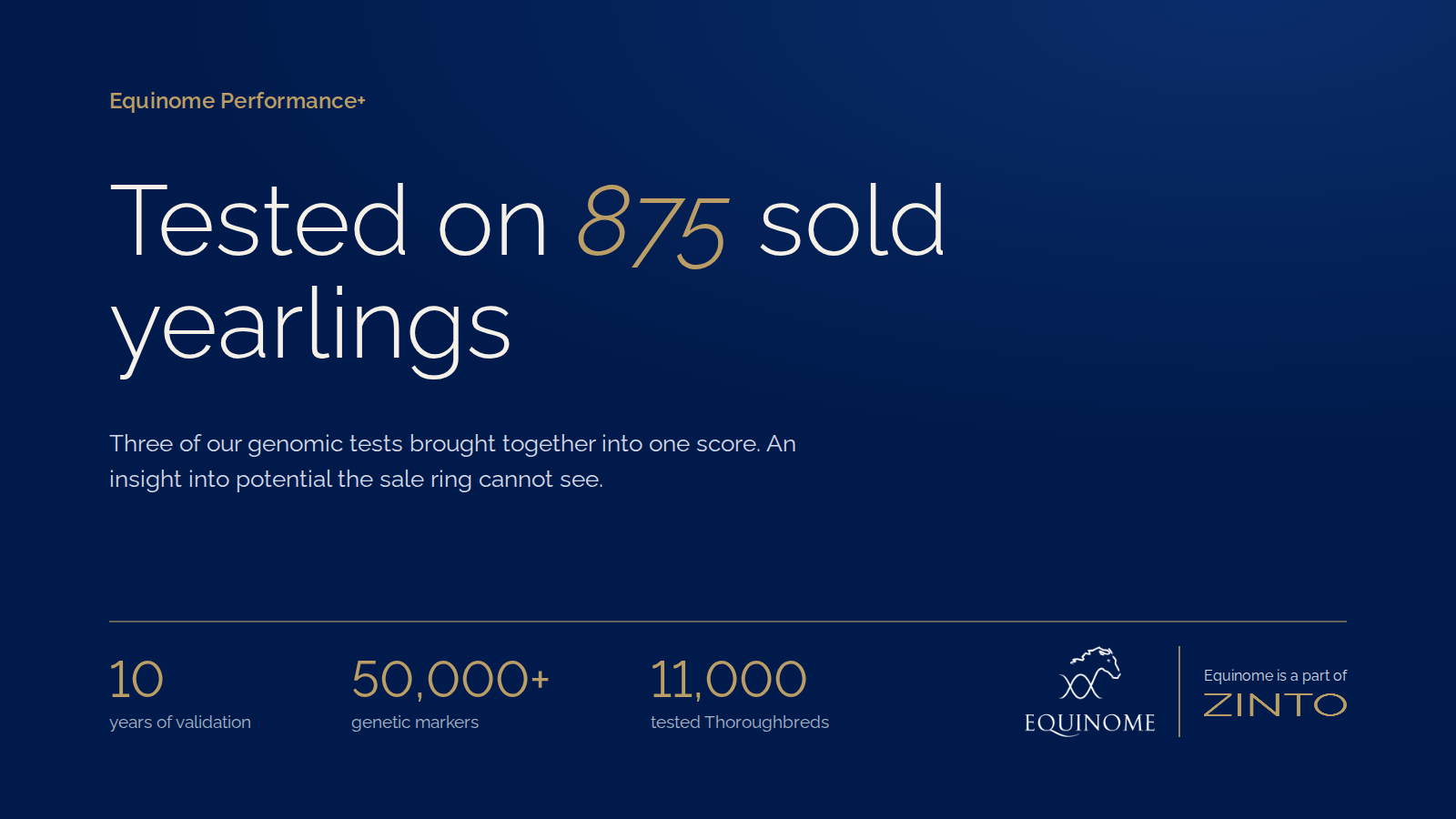
Study of 875 yearlings sold at the 2014 and 2015 Australian sales, with DNA samples provided before the sales and race records to date. Tiers each hold about one third of horses. Earnings compared as medians. Top stables = the top third of trainers by the results of their other horses. Results describe a population and do not predict the outcome for any individual horse.
Equinome Performance+
Three genomic tests. One racing prediction score.
We now have 10 years of data tracking 11,000 tested Thoroughbreds from DNA test to racetrack. It confirms that our Genomic Racing Value, Genomic Inbreeding Value and Raced/Unraced Potential tests identify a genetic advantage to racecourse success.
Research has determined how each test contributes to performance in a different way. We have now modelled them together into a single score: Equinome Performance+.
What the results show
High Performance+ yearlings typically earn 60% more prize money than Base. Medium yearlings typically earn 28% more.
It is more than prize money. Compared with Medium and Base horses, High-scoring yearlings race more often, perform better each time they run, and are more likely to reach the top levels.
How it works
Each test captures largely different genetic information. Together they give a more reliable read than any single test alone. Every horse receives a 0–100 score to rank a group, and a Base, Medium or High tier for a quick read.
Identify your highest potential horses before finalising your sales or training decisions.
Find out more about Equinome Performance+
To test your yearlings, contact our team at sales@zinto.com.
Based on 11,000 tested Thoroughbreds from across the globe with Equinome genomic results and race records. Results describe a population and do not predict the outcome for any individual horse.
A genetic leap forward for sport horse breeding
Zinto Labs announces its first proprietary test for the genetics of health and performance in sport horses, predicting a horse’s suitability for show jumping or dressage with around 90% accuracy.
Today marks a significant milestone for Zinto Labs as we announce our first new proprietary test for the genetics of health and performance in sport horses.
Predicting whether a horse is genetically suited to show jumping or dressage – with around 90% accuracy – is a genuine leap forward for sport horse breeding. For breeders and trainers, that means large cost savings, more focused effort, and more horses trained for what they can truly excel in.
What excites us most is the breadth of application: from identifying a foal’s optimal discipline at birth, to finding the right second career for a retiring racehorse.
Genetics doesn’t replace horsemanship – it informs it.
This continues our commitment to peer-reviewed science. The study is published in the journal Animal Genetics and it’s just the beginning of what our new genomic tools can do for the sport horse world.
Read the study →
Full paper: onlinelibrary.wiley.com/doi/10.1002/age.70146
“Undeniable on the Track”: Inside the Genomics Test Winning Over Racing’s Top Teams
Beyond the Pedigree: How Genomics Is Reshaping the Way Champions Are Trained
For as long as there have been racehorses, trainers have leaned on pedigree to guide the big decisions. Bloodlines, sire records, the achievements of a dam’s earlier progeny, this is the language the industry has spoken for generations, and for good reason. But it has always described a horse’s potential rather than its reality. It tells you the family a horse comes from, not necessarily the athlete standing in front of you.
Today, genomics is beginning to fill that gap, adding a new layer of understanding that reveals what’s happening beneath the surface of each individual horse.
A closer look at how a horse is built
At the centre of this shift is the Zinto Labs Equinome genomics test, helping some of the sport’s leading racing teams understand how each horse is genuinely built to perform. Rather than replacing the trainer’s eye, it sharpens it, putting hard data behind instincts that were previously a matter of experience and feel.
The insights span the things trainers care about most: how a horse’s muscle is likely to develop, the race distances it’s naturally suited to, and the rate at which it’s likely to progress and mature. Taken together, that picture helps teams make smarter, better-timed decisions about training and placement, knowing when to push, when to wait, and where a horse is most likely to be competitive.
It’s the difference between managing a horse on assumption and managing it on evidence.
“A test we refer to quite often”
For renowned trainer Ciaron Maher, that evidence has become part of the everyday routine rather than a one-off curiosity. “It’s a test we refer to quite often,” he explains, describing how it “supports decisions throughout a horse’s training.” In an environment where small margins separate a place from a win, having an extra, objective reference point is something his team returns to again and again, not just early in a horse’s career, but as it develops and its programme evolves.
That confidence is echoed on the data side of the operation. Josh Kadlec-Cavanagh, Head of Data & Performance at Ciaron Maher Racing, is responsible for turning information into a competitive edge and he doesn’t hedge on the value of the genomic insight. “The results are undeniable for us on the track,” he says.
For a modern racing operation that treats performance as a discipline in its own right, that’s a meaningful endorsement. It reflects a wider change in how the best teams work: decisions increasingly grounded in measurable data, layered on top of the horsemanship that has always defined the sport.
From assumption to evidence
The value of genomic data isn’t limited to a single stage of a horse’s life. Whether it’s identifying raw sprint power or mapping out a genuine endurance profile, the same underlying insight informs choices from the yearling paddock through to race day.
For breeders, that means the ability to make more confident matings and selections, understanding not just which horses come from fast families, but which individuals carry the traits that actually drive performance. For trainers, it means placing horses in the races that suit them and building programmes around how each animal is likely to mature. And for owners, it means decisions backed by something more solid than hope.
None of this displaces the craft at the heart of racing. Genomics doesn’t train a horse, and it doesn’t win a race. What it does is turn long-held assumptions into evidence, giving the people who make the decisions a clearer view of the athlete they’re working with.
Landmark Genomics Study of Inbreeding
We’re proud to have collaborated with Greyhound Board of Great Britain on a major new genomics study.
At Zinto Labs & Equinome, our focus is on generating robust genomic insights that can directly inform long-term health, welfare, and sustainability.
Published in Proceedings of the Royal Society B: Biological Sciences, this work represents the most comprehensive population genomic analysis of racing greyhounds in Great Britain to date.
By characterising genetic diversity and population structure, the study establishes a strong scientific foundation for evidence-based, welfare-oriented breeding strategies, supporting healthier outcomes across the full lifespan.
As highlighted by Emmeline Hill, Professor in Equine Genomics at University College Dublin, CSO of Zinto & Equinome, and lead scientist on the study:
“These genomic insights give us the clearest picture yet of the racing greyhound population in Great Britain. High inbreeding is a concern because it can increase the risk of negative health impacts. The key welfare opportunity is to now use modern genomic tools to manage diversity judiciously, preserving what makes greyhounds remarkable while reducing the likelihood of inadvertently concentrating harmful variation.”
“Our commitment at Zinto is to apply the latest science to develop practical tools that support healthier breeding and better lifetime outcomes for greyhounds, and other animals bred for sport”, continued Hill.
Mark Bird, CEO of GBGB, said:
“As the regulator of licensed racing, upholding the very highest standards of animal welfare is a priority for us, which is why it was so important for us to commission this research. All of our welfare policies and practices are based on robust scientific evidence and the findings from this research will be used to inform our guidance for breeders as well as our Rules of Racing so that we can continue to safeguard the health and wellbeing of all our greyhounds.”
Madeleine Campbell, Professor of Veterinary Ethics at University of Nottingham, Independent Director of GBGB, and co-author of the research paper said:
“This novel study provides a scientific evidence-base for welfare-oriented breeding decisions and is an important step in optimising the welfare of racing greyhounds across their lifetimes”.
This work demonstrates how applied genomics can deliver actionable, real-world impact.
Read the study →
https://royalsocietypublishing.org/rspb/article/293/2069/20252552/481511/Genomic-diversity-and-selection-in-the-racing
Horses can have individual responses to stress: Latest published research findings
The modern domestic environment of the racehorse is much different from that of the wild habitat the horse once adapted to survive in. Prior to domestication, as a prey animal, horses relied on being vigilant to potential threats and having quick reactions to escape danger. The ‘fight or flight’ response is responsible for assessing and acting on possible threats. When animals encountered new, potentially dangerous situations they enter a state of stress in order to process and act accordingly. Some individuals may find the same situation more or less stressful, and for those that have heightened stress responses, chronic stress could negatively impact on several aspects of health.
Plusvital scientists, with researchers at University College Dublin, Ireland, measured the stress hormone cortisol to examine individual differences in stress responses of yearlings encountering the new training environment and milestone early training events. The research was part of a four-year PhD research project that investigated genetic contributions to behaviour in young racehorses and has been published in the peer-reviewed journal PLOS ONE.
Lead scientist, Dr Amy Holtby said, “This research provides scientific evidence to support the idea that horses have individual stress responses to the same situation and should be managed accordingly. We found that the greatest difference in the cortisol biomarker among yearlings was the first time they were backed.
“Currently trainers modify and adjust a horse’s training routine to best suit the individual needs of each horse. This approach could be fine-tuned with scientifically-developed biomarkers. Developing robust biomarkers for assessing horse welfare is a fundamental part of how we can best support the highest standards of welfare in racing”.
Link:
https://journals.plos.org/plosone/article?id=10.1371/journal.pone.0284102
Stressed out: New insights for racehorse welfare from cutting-edge genomics research
Temperament is often referred to by winning connections as a crucial element of a racehorse’s success. Temperament reflects patterns of thought, behaviour and emotion and includes the ability to cope with the demands of training. Horses that do not easily adapt to the training environment may have extended periods out-of-training and unsuitable temperament is responsible for one in 16 thoroughbred horses discontinuing a racing career. Temperament traits therefore have animal welfare and economic implications, and may impact on handler and rider safety.
Scientists at University College Dublin and Plusvital Ltd, Ireland, have published new research in the peer-reviewed journal Animal Genetics, which describes the discovery of genes that are associated with stress and coping in the training environment. The article titled “Integrative genomics analysis highlights functionally relevant genes for equine behaviour” is the result of a four-year PhD research project that examined the stress hormone cortisol and the results of a questionnaire in 100 yearlings as they encountered key milestone events during the early training period.
Lead scientist on the project, Dr Amy Holtby said, “The most stressful event for a young racehorse is the first time it is backed by a jockey, with studies showing that it causes the greatest cortisol response in the horse. Some horses cope better than others, with lower cortisol reactions.”
A key finding of the research was that observations of the yearlings’ behaviour by highly experienced handlers did not agree with the cortisol results, indicating that cortisol identifies a distinct aspect of the stress response that is not perceivable to handlers.
Senior scientist, Professor Emmeline Hill said, “This means that some horses experience stress without acting out, and this could have detrimental long-term effects if it cannot be managed appropriately. Identifying genetic markers for the stress response could therefore have value in identifying horses most susceptible to stress.”
The scientists compared the genetic profiles of the yearlings that were best able to cope with early training to those less able to cope. Next they used genetic data from two different brain tissues that regulate the fear response and the modification of behaviour to pinpoint the genes that were most likely to impact on the ability to cope. This approach highlighted a set of genes that function (in other species) in social behaviour, suicide, stress-induced anxiety and depression, neurodevelopmental disorders, neuroinflammatory disease, fear-induced behaviours, and alcohol and cocaine addiction.
The gene that was most important in the thoroughbred stress response was NDN (necdin). This gene is associated with temperament in cattle, measured as ‘flight time’ (the time taken for an animal to reach a fixed distance following release from an enclosure). In mice the gene is associated with behaviour traits, and in humans it is associated with paranoia.
Dr Holtby said, “Everyone involved with racehorses recognises the importance of maintaining the mental well-being of their animals and balancing the training routine to keep them happy and engaged with their work. It is one of the most crucial aspects of training.”
Professor Hill said, “Genetics doesn’t have all the answers, but our research provides a sound scientific basis for genetic screening tools to support the highest welfare standards for the thoroughbred.
“The ‘nurture’ aspect of behaviour is of course a major factor, with the management of the animal impacting on its temperament. Our research has revealed genetic markers that could be used to identify animals that will benefit most from more nuanced handling. In time these makers could also be developed into tests to inform breeding decisions.”
Journal: Animal Genetics Animal Genetics – Wiley Online Library
Special Issue: Functional Genomics and Annotation of Domestic Animals
Direct access link to scientific paper: https://doi.org/10.1111/age.13320